

Introduction
The Business Model Canvas (BMC) developed by Osterwalder provides a valuable framework for new venture creation. However, applying the BMC specifically to startups requires adapting some standard element definitions. In this article, I offer my interpretations of the BMC tailored to the startup environment.
My perspective applies a more behavioral lens, focusing on understanding customers’ underlying needs and desired outcomes. The goal is to design solutions facilitating key behaviors to deliver customer-centric value. I describe customer problems, behaviors, motivations, and obstacles.
For example, I expand the Customer Segments element beyond demographics to capture contextual insights, behavioral patterns, and barriers customers face. The Value Proposition focuses on quantifiable outcomes the customer seeks, not just the startup’s offerings. Channels and Customer Relationships outline engagement strategies across the entire customer journey, not just transactions.
I encourage startups to identify Key Activities as core competencies required to solve customer problems versus listing generic functions. One should derive resources and partnerships from these competencies. The emphasis is leveraging business model elements to create holistic, human-centered value.
In addition to redefining BMC elements, I offer tools to aid in designing and testing assumptions. I discuss fostering a culture of experimentation and continuous iteration. I explore applications of the BMC beyond startups, such as assessing new ideas, improving operations, and aligning organizational culture.
In summary, I aim to provide founders with a BMC interpretation optimized for the startup environment while also demonstrating the canvas’ versatility to serve organizations broadly. With the proper adaptations, the BMC can help turn business ideas into models ready for sustainable realization.
The Strategic Value of Business Modeling
Applying business model frameworks like the BMC has become a standard practice for new venture creation, primarily due to the influence of the lean startup methodology. This approach views startups as temporary enterprises searching for a repeatable and scalable business model through continuous experimentation and iteration.
The BMC provides a structured way for founders to design a new venture holistically as an interconnected set of hypothesized business activities. By visualizing the model, founders can articulate how the business provides value to customers.
Mapping the business model encourages founders to consider every aspect of the venture, not just the product. Innovating across business model elements creates opportunities for competitive differentiation beyond unique product features. For instance, founders can discover new marketing channels, revenue models, partnerships, and customer engagement strategies.
The BMC also fosters a culture of experimentation and data-driven decisions. By quantifying model elements and embedding hypothesis testing, founders take a scientific approach to validating assumptions. This culture of iterative testing enables sustained innovation as the model evolves.
The BMC delivers strategic value for new ventures by:
- Providing a framework to design all business activities holistically
- Identifying innovative ways to differentiate beyond the product
- Encouraging hypothesis testing and data-driven decisions
- Facilitating continuous improvement through iterations
- Producing actionable metrics to monitor performance
Applying the BMC strategically helps create ventures ready for sustainable, scalable realization driven by delivering customer value.
Avoiding Founders’ Tunnel Vision
Many aspiring entrepreneurs fall into the trap of focusing too narrowly on specific aspects of their venture, such as product development and marketing. This limited perspective can be detrimental to startup success. By concentrating solely on pieces of the business, founders often fail to consider the venture holistically and ensure alignment across all activities.
It is common for founders to become enamored with their product idea, falling victim to cognitive biases like confirmation bias. However, having the most innovative product means little if customers do not see its value or it is not delivered correctly. To achieve product-market fit, founders must align their offerings with customer needs and ensure effective distribution and service strategies exist.
Additionally, strategies for supply chain management and partnerships are crucial. A standalone product does not make a business. Employing a structured business model like the BMC encourages founders to take a comprehensive view across all facets of the enterprise.
In the early stages, some argue that modeling the entire business is premature before clearly defining the customer problem context. However, consider drafting the initial business model in a more generic, assumption-based form for subsequent testing and iteration. For instance, the value proposition can focus on the general outcomes a solution would provide before detailing specific product features.
While avoiding a narrow perspective is crucial, founders need structured frameworks to take a holistic view when designing their ventures. Business model tools like the BMC enable this comprehensive approach.
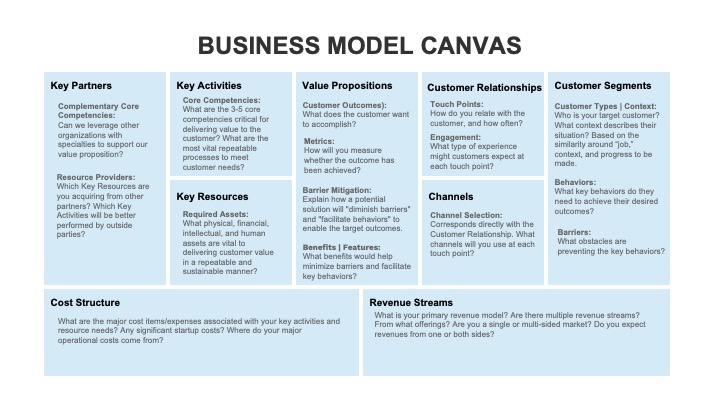
Where to Start
While there are several opinions on where to start, I suggest founders focus on Customer Segments and Value Proposition in the early brainstorming activity. These two elements are essential for illustrating the alignment between your customer’s needs and your product offering, often called the problem-solution or product-market fit.
Many founders focus on an initial product solution they assume to be missing from the marketplace. While the original BMC is structured to support an early conception of the solution, I always advise entrepreneurs to take a step back and look at the customer need areas. The best practice starts by clearly articulating the customer’s needs, problems, and context.
A Behavioral Perspective
The Business Model Canvas (BMC) provides a structured visualization of the critical elements of a business model. My interpretation of the BMC elements differs from traditional applications by emphasizing desired customer outcomes, behaviors, and obstacles. I take a human-centered perspective focusing on understanding customer motivations, problems, and needs. This view shapes my articulation of the Value Proposition, Customer Relationships, and other components. I aim to highlight a holistic view of each element that places the customer at the heart of business model design and experimentation. This customer-centric focus seeks to facilitate positive behaviors and experiences through the business model. As we explore each component, I will highlight how my interpretations differ from standard definitions to support a lean, experimentation-driven approach to business model development.
Customer Segments
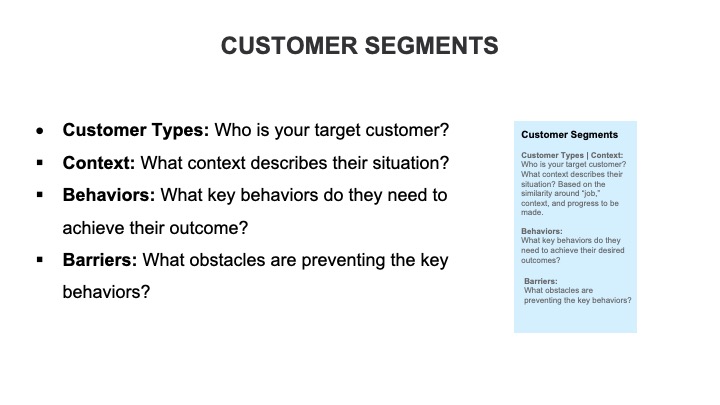
So, let’s focus first on the Customer Segments element in the BMC template. This BMC element focuses on the specific problem you hope to solve and who experiences this problem the most.
I suggest starting by identifying the various customer types and groupings that comprise your target market. Consider relevant categories like demographics, psychographics, behaviors, attitudes, and other distinguishing factors. Understanding these customer types will help you effectively segment your broader market.
At this point, I always advocate that startups consider a primary customer segment or “beachhead” to focus on early in the process. You want to focus on a primary target as you engage early customers and test many of your BMC assumptions. Then, in later BMC iterations, you will refine the customer segments to reflect your primary target markets.
Secondly, you want to decide if your business model will include customers from two or more market sides. Sometimes referred to as two-sided or multi-sided markets, these business models require engagement with multiple types of customers. A typical scenario has your venture matching two customers. One needs a solution (demand-side), and another supplies an applicable product or service (supply-side). You should add both of these customers to your BMC. You will quickly discover that each side has its objectives, needs, and pain points. Your future offering will have to address the needs of both sides. As you will see shortly, the value proposition will inevitably differ for each side of the market, so you must identify and align both within these first two BMC elements.
Next, consider the context in which customers experience the problem or need your solution addresses. Think about situational factors, locations, events, or other circumstances that surround the customer’s experience. Understanding the context provides insights into how and when your solution will provide value.
With the customer types and context defined, focus on articulating the key customer behaviors related to the problem. Outline the specific actions, tasks, and activities customers take to achieve their objectives or fulfill their needs. Gaining clarity on these behaviors will reveal opportunities to improve their experience.
Finally, identify the significant barriers and obstacles that hinder customers from effectively demonstrating these behaviors and achieving their desired outcome. These barriers become the “pain points” your solution aims to eliminate through your value proposition. Quantifying these obstacles also provides metrics to measure your solution’s impact.
At this point, I always advocate that startups consider a primary customer segment or “beachhead” to focus on early in the process. You want to focus on a primary target as you engage early customers and test many of your BMC assumptions. Then, in later BMC iterations, you will refine the customer segments to reflect your primary target markets.
Secondly, you want to decide if your business model will include customers from two or more market sides. Sometimes referred to as two-sided or multi-sided markets, these business models require engagement with multiple types of customers. A typical scenario has your venture matching two customers. One needs a solution (demand-side), and another supplies an applicable product or service (supply-side). You should add both of these customers to your BMC. You will quickly discover that each side has its objectives, needs, and pain points. Your future offering will have to address the needs of both sides. As you will see shortly, the value proposition will inevitably differ for each side of the market, so you must identify and align both within these first two BMC elements.

Value Proposition
Once you have addressed your preliminary assumptions about the customer’s objective, context, and priority segment, you can turn your attention to the Value Proposition element of the BMC. This BMC element focuses on answering the following question: What value is your customer seeking from an effective solution?
Start by defining the desired customer outcomes that an effective solution would provide. These are the tangible results and benefits customers want to achieve. Quantify these outcomes with metrics whenever possible, as it provides baseline data to measure a solution’s impact.
Next, outline how a solution will mitigate the significant barriers and pain points customers face. Demonstrate how an offering will reduce obstacles, alleviate frustrations, and remove blockers inhibiting customers from succeeding.
With the outcomes and barrier mitigation defined, detail the specific features and benefits a solution will deliver. Consider both functional and emotional benefits from the customer’s perspective. Functional benefits enable customers to do something better, faster, or more efficiently, while emotional benefits make customers feel happier, less stressed, more confident, etc.
Finally, briefly summarize how a solution delivers a unique combination of outcomes, barrier mitigation, and benefits that customers cannot get elsewhere. This combination highlights the competitive differentiation.
Building the BMC Before vs. After Validation
There is a difference between building an initial BMC before validating customer outcomes and behaviors versus constructing a BMC after validation when a product already exists in the market. In the early stages, the BMC represents hypothesized elements and assumptions to be tested and refined through experiments. The goal is to achieve product-market fit. In later stages, the BMC depicts a validated model based on learnings from real customer engagement. At that point, the focus shifts to optimizing and scaling the validated business model.
Opportunity-Solution Fit
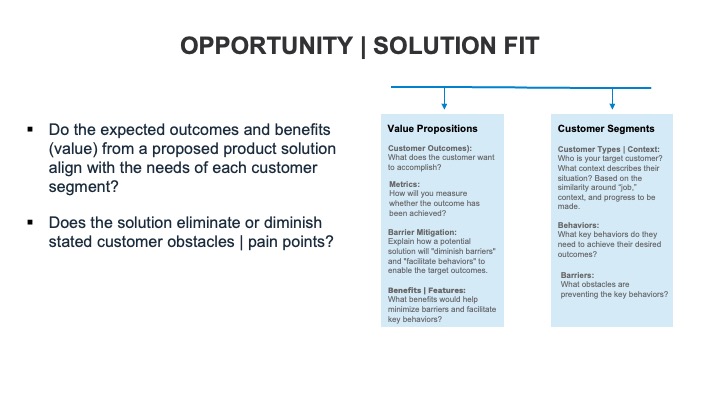
he alignment between the customer segment information and value proposition elements represents the degree to which a proposed solution matches the needs and desires of the target market. One often refers to this crucial linkage as an opportunity-solution fit.
Achieving opportunity-solution fit should be the primary focus during the early stages of venture creation. Properly validating and aligning the customer and value proposition components provides the foundation for a viable business model. Everything else in the model revolves around delivering the value proposition to the prioritized customer segment(s).
Continuously testing assumptions about the target customers, their needs, desired outcomes, and pain points is imperative. You must apply the same rigor to assumptions about the benefits a potential solution delivers. Interviewing target customers, observing their behaviors, and running experiments to identify metrics are essential.
Only with proper validation of Customer Segments and Value Proposition can you achieve an opportunity-solution fit. This proven alignment gives confidence that customers need and want what you aim to deliver. Otherwise, you risk misalignment and building solutions that customers do not find valuable.
As you engage with early customers and refine your BMC, constantly evaluate if the opportunity and solution remain aligned. Making pivots to the business model is expected. However, maintaining an opportunity-solution fit is necessary for long-term success. No amount of business model innovation will succeed if this vital alignment is missing.
Consider Early Customer Engagement Strategies in Business Model Canvas
Identifying your customer’s needs, pain points, and desired outcomes is essential to developing a successful venture. The alignment of these two elements establishes the focal point of the transaction between you and your customer. Once you identify these assumptions, you can look at all necessary actions to make the transaction repeatable and scalable.
As you better understand the alignment between your product or service ordering and target customers who may want your solution, you can start to outline two other customer-related elements: Customer Relations and Channels. I see these two elements as your venture’s areas of customer engagement; how and where will you connect with your customers to establish a long-term brand relationship?
Customer Relationships and Channels
Customer Relationships and Channels represent critical components of your customer engagement strategy. These elements address how and where you will connect with customers throughout their journey with your product or service.
Customer Relationships outlines the interactions you aim to foster with customers over time. These interactions span from when they first become aware of your offering through the sales process to post-purchase support and retention. Defining these relationship strategies is essential for acquiring, serving, and keeping customers.
Channels refer to the methods and forums you use to reach your customers, deliver your offering, and facilitate communication. Channels must align with relationship strategies and map to crucial stages of the customer journey. Omnichannel approaches recognize customers engage across both physical and digital channels fluidly.
Getting these elements right enables you to engage effectively throughout the customer lifecycle. You meet customers where they are, move them towards purchase, and keep them satisfied post-sale. Customer Relationships and Channels are integral to your customer engagement strategy and overall business model.
Customer Relationships
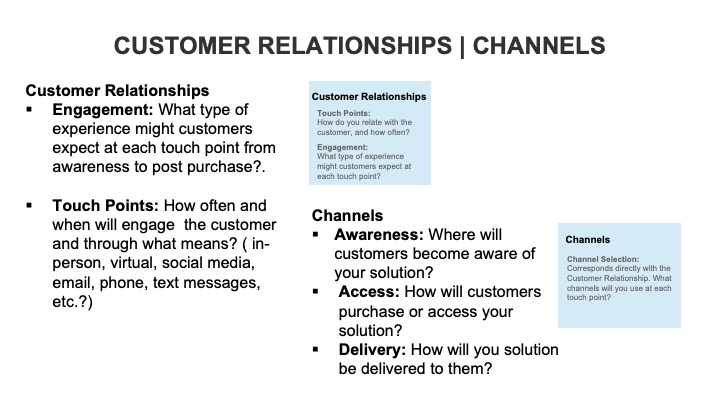
The Customer Relationships section describes the engagement strategies and touchpoints you plan to have with customers throughout their journey with your product or service.
Start by outlining the critical stages of the customer lifecycle, from initial awareness to post-purchase. Map out what interactions you aim to facilitate during each stage to move customers toward purchase and loyalty. For example, you may want to educate potential customers at the awareness stage, consult with them during research and evaluation, provide account management through purchasing, and supply support post-sale.
Then, define the types of touchpoints, such as education, consultation, account management, and customer support, you will use during each stage. Consider a range of options from automated to high-touch personal outreach. For instance, you may use webinars to educate, phone consultations during research, in-person account managers for larger purchases, and online help centers for support.
You also want to determine the appropriate frequency and cadence for engagements based on product/service complexity, sales cycle length, and customer expectations. For example, a complex B2B solution may require multiple consultations over weeks or months, while a simple consumer app may only need an initial download education sequence. Mapping the stages of the customer journey provides a blueprint for customer relationship opportunities over time.
There are always trade-offs to evaluate. For example, high-touch offerings allow for customized solutions but have higher costs. Low-touch models are more accessible to scale but less personalized. You may need a hybrid approach, with automation for simplicity but high-touch for priority accounts. Finding the optimal engagement cadence requires evaluating these trade-offs between relationship models for each customer segment.
Defining these engagement strategies and touchpoints enables customized relationship models across the customer lifecycle. While customer relationships focus on the types of interactions, distribution channels represent where these touchpoints can occur to form bonds with customers.
Channels
The Channels section refers to the methods and forums you use to reach customers, deliver your offering, and facilitate communication throughout their journey.
First, consider channels to generate initial awareness of your product or service. These methods may involve digital advertising channels like search ads or social media promotions, events like conferences and tradeshows, professional referrals, or other exposure opportunities.
Then, outline the channels customers will leverage to research and evaluate your offerings, such as your website, third-party review sites, retail outlets where they can see products, sales representative consultations, and product demo opportunities.
When defining purchase and delivery channels, determine if you will sell directly to consumers through your e-commerce site, use distributors like Amazon or retail outlets, utilize in-person sales teams, or some combination. Also consider delivery methods – digital, in-store pickup, or shipping.
Post-purchase support channels like email, online knowledge bases, user forums, communities, call centers, and in-person service centers will be vital for retaining customers.
Carefully evaluate digital and physical channel options across each stage of the customer journey – awareness, evaluation, purchase, delivery, and support. Omnichannel approaches meet customers through the channels that are most convenient for each need. For example, a customer may become aware through a digital ad, research the product on your website, purchase the item at a retail store, and engage customer support via online chat.
The optimal mix of channels evolves and should align with customer relationship strategies. Continually review channel data and optimize based on performance.
Supporting Customer Value Through Internal Infrastructure
The following three elements of the BMC – Key Activities, Resources, and Partnerships – represent the internal infrastructure required to deliver value to customers repeatedly.
I define Key Activities as the core competencies and areas of expertise essential for providing your value proposition. Rather than focusing on generic operations, determine the capabilities your enterprise must master to solve customer problems and meet needs sustainably. These distinctive competencies set the foundation.
Once you identify the pivotal Key Activities, you can determine the critical Resources needed to perform those activities excellently. Resources may include specialized human capital, intellectual property, infrastructure, or other assets that support building core competencies. Resources and Activities are closely linked.
With the required Activities and Resources defined, you can identify competency gaps and risks. This assessment lets you determine optimal Key Partnerships that can provide specialized support, mitigate weaknesses, enhance distribution, and reduce costs. Partnerships complement internal infrastructure.
Getting the mix right between internal Activities and Resources and external Partnerships is crucial for executing the business model and delivering customer value in a repeatable, scalable manner. These elements work together to build a supportive infrastructure for the venture.
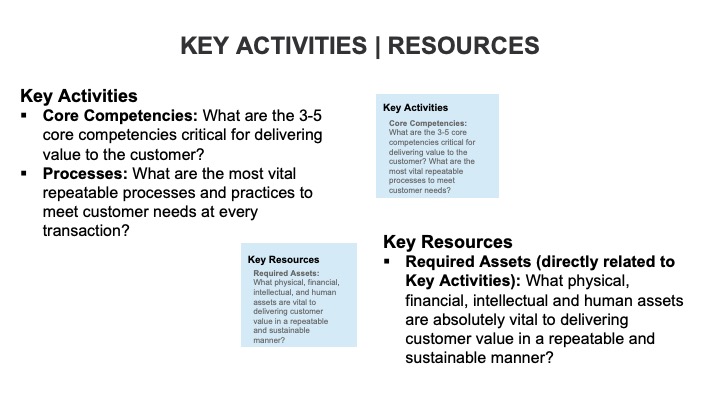
Key Activities & Resources
Key Activities refer to the essential expertise, capabilities, and operations your enterprise must master to deliver value to customers repeatedly. Rather than listing generic functions, focus on identifying your distinctive competencies and proprietary processes that enable your value proposition.
For example, if you are developing a software-enabled solution, key activities may include agile product development, user experience design, and data analytics capabilities. For a manufacturing company, key activities could consist of proprietary production processes, industrial engineering, and quality assurance procedures.
Once you define the key activities, you can outline the critical resources needed to support them. These resources may involve specialized human capital like engineers, data scientists, or industry experts. Key resources include intellectual property, infrastructure, production facilities, technology, and real estate assets. Align and map resources to support the prioritized activities.
For instance, a biotech startup focused on drug discovery may require lab equipment, patented processes, and research scientists as key resources to support their R&D activities. An e-commerce company could require warehousing and logistics infrastructure to support operations and fulfillment.
Concentrate resources on the capabilities and operations that are genuinely essential for delivering your customer value proposition sustainably. Key activities and resources should enable you to exceed customer expectations repeatedly.
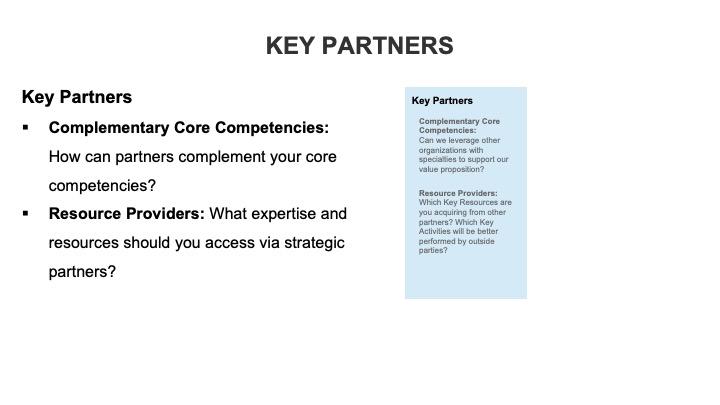
Key Partnerships
Key Partnerships help fill strategic gaps in expertise, capabilities, and infrastructure to enhance your business model execution. Partnerships serve as a bridge to obtain external activities and resources that are not obtainable internally. This circumstance happens frequently due to a lack of startup capital.
Identify industry experts and established players that can provide insights, access, and credibility. For example, an education startup could partner with leading academics to bolster their curriculum. Or a healthcare provider could ally with an existing hospital system to expand their reach.
Evaluate opportunities to have partners take on essential but non-core activities through licensing, white-labeling, or outsourcing arrangements. This approach allows you to focus on your distinctive competencies. For instance, partnering with a cloud provider to enable technology infrastructure vs building in-house.
Seek channel partners who can improve distribution, marketing, and sales through their industry relationships and existing customer bases. Their reach can help scale faster.
Carefully assess what activities and resources must be proprietary vs. where external parties can fill gaps just as effectively. Balance build vs buy decisions to optimize expertise, economics, focus, and growth.
Cultivate partnerships with a diverse range of entities – suppliers, academia, industry groups, technology providers, and channel marketers – to build the most robust foundation for delivering an unmatched value proposition.
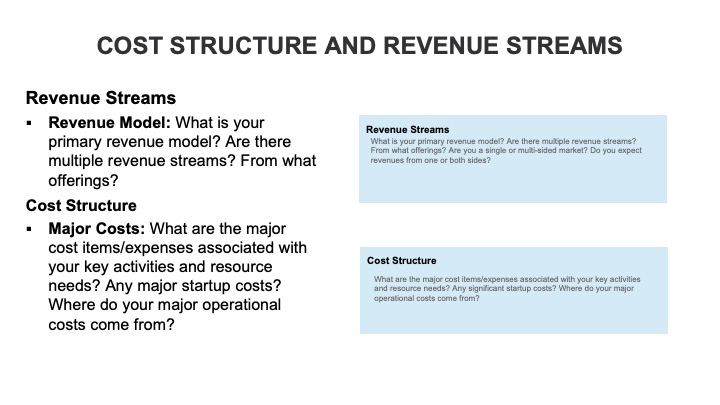
Profit Model Elements
When initially completing the Cost Structure and Revenue Streams elements of the BMC, actual dollar amounts are not necessary. The goal is to outline the key drivers of costs to deliver your value proposition and how you plan to generate revenue.
Cost Structure
The Cost Structure outlines the critical monetary expenditures for building and managing the core competencies and resources needed to deliver your value proposition. Rather than listing all costs, focus on the drivers related to performing key activities and acquiring key resources.
For example, the cost structure for a software company would highlight needs like technical talent, development tools, cloud infrastructure, and cybersecurity. It does not require specific salary figures, budgets, etc. The goal is to identify key areas you need to fund.
Underestimating these foundational cost drivers early can undermine the economics of the whole business model later. Have experts review assumptions to avoid surprises. Also, build in buffers for unforeseen expenditures.
Revenue Streams
The Revenue Streams section defines how you will generate income from each customer segment. Outline how customers will pay for products and services.
For example, consider transaction models like one-time purchases, subscriptions, usage-based pricing, and advertising models. Also, determine payment modes – credit, debit, pre-payment, installment plans. No need for specific pricing yet.
In two-sided markets, be transparent about which sides pay. For instance, a ride-sharing app may take a percentage of driver fares riders pay. An e-commerce site may charge sellers a transaction fee on top of customer purchases.
Testing Assumptions and Fostering Experimentation
Forming hypotheses and running experiments to test all parts of the business model is fundamental for startups. This process of validating assumptions and learning through real-world tests is central to the lean startup methodology. Rather than relying on intuition, founders need to take a scientific approach.
The Business Model Canvas provides a framework to guide this process of experimentation. The canvas makes assumptions about each model component explicit. One can design experiments to validate or invalidate those hypotheses. Customer interviews, prototypes, landing pages, A/B tests, and other methods provide empirical data to confirm or refute assumptions.
Building a culture focused on continuous experimentation is vital for startups. It enables evidence-based decisions rather than gut instinct. Employees should feel empowered to try new ideas and share results transparently. Even “failed” tests provide valuable learnings to improve the business model.
When designing experiments, founders must consider criteria such as:
- Fidelity – How closely does the test mimic reality? Higher fidelity provides more accurate data.
- Cost – What is the spend required to run the test?
- Duration – How long will the experiment take?
- Capacity – Do you have resources available to analyze and implement findings?
- Concurrency – Can multiple tests be run simultaneously?
- Controls – Is there a control group or variables being isolated?
Business Model Types
There are various types of business models to consider when structuring your BMC. The model type you select can have a significant influence on what components you emphasize in the canvas.
Business to Consumer (B2C):
The Business to Consumer (B2C) model focuses on companies selling products or services directly to end customers. For example, an e-commerce company that sells household goods online directly to consumers may structure around a B2C model. Key activities may include supply chain management, online merchandising, order processing, and fulfillment. The associated key resources could consist of warehousing infrastructure and delivery fleet vehicles. Revenue streams come directly from individual consumer purchases rather than selling through intermediaries.
Business to Business (B2B):
In a Business to Business (B2B) model, companies sell products and services to other businesses rather than individual consumers. For instance, a company providing cloud-based business analytics software would follow a B2B model, selling to other companies. Key activities may involve data science, executive relationship building, and value-based pricing models. Key resources could include data scientists and proprietary algorithms. Revenue comes from business customers for the software rather than consumers.
Multi-sided (B2C & B2B):
Multi-sided platforms provide value to both end consumers and business customers. For example, a credit card company issues cards to consumers and partners with merchants and banks. Its BMC needs to incorporate both B2C segments that use the cards and B2B partners. Value propositions, revenue streams, and partnerships may differ for each side. Key activities could involve risk modeling, security protocols, and platform optimization. Key resources may include data repositories and fraud detection capabilities.
Peer to Peer (P2P):
Peer-to-peer models create marketplaces that connect individual buyers and sellers directly. For instance, an online platform that allows people to sell used items to other individuals is peer-to-peer. Key activities may involve building trust and safety measures, dispute resolution processes, and community engagement. Key resources could include identification verification systems and customer support staff. Revenue may come from taking a percentage of transaction volumes rather than directly selling products.
Business to Business to Consumer (B2B2C):
In a B2B2C model, a company sells products and services to intermediary businesses that resell to end consumers. For example, a manufacturer sells electronic components to a computer OEM to assemble PCs for individual buyers. Key activities include managing channel partnerships and building brand recognition. Key resources may consist of industry certifications and strong distribution networks. The BMC must incorporate both the business customers as well as end consumers.
Consumer to Business (C2B):
The Consumer to Business model facilitates individuals to sell goods, services, or ideas to organizations rather than just to other consumers. For instance, an influencer marketing platform that connects companies with social media influencers to promote products. Key activities could involve influencer relationship building and campaign management. Key resources may include proprietary influencer databases and content creation tools. The BMC enables monetization capabilities for the influencers while providing access to influencer networks for businesses.
In summary, the type of business model you select can significantly impact your BMC components. Matching the model to your customer segments and value propositions is vital for effectively delivering and capturing value. Consider both direct and indirect routes to provide value at scale. Ensure your key activities, resources, and partners reflect the domain expertise and core competencies needed to excel in your chosen business model. Matching model requirements with genuine strengths will enable delivering and capturing value optimally.
Leveraging the Business Model Canvas
The Business Model Canvas is a versatile framework that can provide value beyond just modeling a new startup. Established organizations can use the BMC to analyze markets, optimize operations, plan initiatives, and align culture.
Evaluate New Business Ideas
The BMC is a valuable tool for evaluating and developing new business ideas. It provides a structured way to analyze all aspects of a potential venture to determine viability. Founders can identify target customers, map the value proposition, and model operations to assess sustainability. For instance, the canvas can help determine if an on-demand laundry startup could provide sufficient value and be economically feasible. In addition to new ventures, existing companies can leverage the BMC to uncover improvements.
Discover Improvement Areas
For existing enterprises, the BMC facilitates analyzing current operations to discover areas for improvement. Management can scrutinize channels, cost structure, and partnerships to identify potential optimizations or realignments. For example, a retailer could use the canvas to consider omnichannel sales and find ways to enhance customer experience. The BMC also aids planning for innovations like new products and services.
Develop New Products/Services
When preparing to launch new products or services, the BMC provides a framework for modeling how they will integrate with existing business activities. For instance, a SaaS company can outline how add-on features will impact value delivered to current customer segments. The visual nature of the BMC supports strategic analysis of competitive forces.
Analyze Competition & Market
Using the BMC, businesses can benchmark against competitors and analyze market forces. By modeling competitor operations, they can find strategic advantages or identify unmet customer needs. For example, an electronics manufacturer could research competitors and supply chains to position its offering. As companies grow, aligning operations to business model requirements is key.
Align Capabilities & Resources
As companies grow, they can use the canvas to align organizational capabilities and resources with business model needs strategically. For instance, a startup entering new geographical markets can determine the required localization activities and partnerships. Communicating plans with stakeholders is also a key opportunity.
Communicate with Stakeholders
The visual nature of the BMC makes it practical for communicating business plans with stakeholders. Founders can use it to explain the venture to team members, potential partners, and investors. For example, an entrepreneur could map a biotech startup’s operations and funding needs. Finally, the BMC can provide cultural insights.
Identify Value-Driven Culture
Analyzing the BMC can provide insights into fostering an inclusive company culture. Each element can identify specific practices to ensure diversity, equity, and belonging are incorporated holistically. For instance, ensuring marketing channels reach underrepresented groups and partners reflects community priorities.
The BMC is an adaptable framework with applications across planning, optimization, communication, and cultural alignment for new and established ventures. Taking a systematic approach allows organizations to leverage the full strategic potential of the business model canvas.
Conclusion
In this article, I have aimed to provide an interpretation of the Business Model Canvas tailored to the startup environment. My perspective applies a behavioral lens to understand customer needs, motivations, and desired outcomes.
I have redefined certain BMC elements, such as Customer Segments and Value Proposition, to focus on capturing customer problems, contexts, behaviors, and barriers. The goal is to facilitate positive behaviors through human-centered design. Additionally, I emphasize Key Activities as competencies required to solve customer problems rather than generic functions. Resources and Partnerships align to support those competencies.
I encourage founders to avoid bias and tunnel vision by leveraging the BMC to take a holistic view across all business activities. Assumptions should be continuously tested and iterated through experiments.
The BMC is not just for startups. Established organizations can apply it strategically to evaluate ideas, improve operations, plan new initiatives, and align culture.
In summary, the key takeaways are:
- Adapt the BMC for startups by applying a behavioral lens
- Focus on understanding customer jobs, motivations, and desired outcomes
- Identify core competencies to solve customer problems
- Foster a culture of experimentation and continuous iterations
- Take a holistic view across all business activities
- Leverage the BMC flexibly to serve both new and established ventures
Using the BMC with the proper adaptations provides a valuable framework for designing, testing, and realizing business models poised for sustainable success.
 Venture for All®️ LLC